Showing posts with label Malaysia. Show all posts

Taman Negara, National Park - Malaysia

River in Taman Negara.
Taman Negara means ‘national park’, and indeed this is not only the world‘s oldest rainforest, but also the oldest national park in Malaysia. Almost 4,500 sq. km (1550 sq. mi) are protected here, and the park spreads across the west Malaysian states of Pahang, Terengganu and Kelantan. The rainforest has a wealth of biodiversity, dominated by hardwood forest in the lower areas and cloud forest at the higher elevations. There are no roads, and the only way to see it is by trekking the forest trails or by boat on the rivers.

You need to get to Ulu Tembeling by road and continue your journey to Kuala Tahan by boat. There’s an old train station in Kuala Tembeling but the train never stop there anymore. The nearest train station that still functioning until today is at Jerantut railway station. There are also few busses available from the city of Kuala Lumpur.

The landscape of the jungle.

Some beautiful waterfall.

This rainforest is about 130 million years old, which means that while other parts of the planet were undergoing ice ages, this area’s climate is much as it was during the age of the dinosaurs. The flora and fauna are superb — Sumatran rhinoceros, tigers, Asian elephants, sun bears, leopards and tapirs roam, and monkeys and birds chatter and call from the trees. South-east Asia’s tallest tree, the ‘tualang’, grows here and there are hides on the jungle paths, from where you may be lucky enough to see some of the wildlife.

In the north-west of the park is the formidable Gunung Tahan. Standing at 2,187 m (7,175 ft.) it is the highest mountain in west Malaysia. The most amazing experience in this forest is the canopy walkway — the longest in the world at 430 m (1,475 ft.), leading from tree to tree as high as 50 m (165 ft.) above ground. The view of plants and wildlife living at this height is extraordinary.


Taman Negara boat ride.

One of the giant tree in Taman Negara.

Another example.

Penang Hill, Malaysia

Old rides to the top pf Penang Hill.

The Island of Penang is the site of the oldest British settlement in Malaysia, founded in 1786 by Captain Francis Light. Captain Light was searching for the base where ships of the East India Company could set anchor and make repairs. He made a treaty with the Sultan of Kedah, and in exchange for military protection, received permission to colonize in the jungle –covered and virtually uninhabited island.

In the middle of today’s busy, modern city of Georgetown rises Penang Hill (Bukit Bendera). Almost of 833 m (2,723 ft) high, it dominates the island and from its summit there are amazing views not only of the town and the whole island but also, on a clear day, of the mountains on the mainland.

The new coach for the Penang Railway.

The view from the top of Penang Hill.

The hike up Penang Hill takes about two hours, but the best way to see it is to take the funicular railway. Built by Swiss Engineers, this trundles up an incredibly steep angle at a leisurely pace through the tropical forest, allowing you a close look at palms and creepers and cascading tropical flowering trees. At the top is a plateau, with a few shops, a café, a small Hindu temple and a mosque. Here you will also find a tatty 1930s hotel, set in pretty gardens that house a bird sanctuary. Other attractions on the hill include the botanic gardens and the rope walk.


More than that there are many other attractions all around Penang such as Khoo Khongsi, Kok Lok Si Temple, Fort Cornwallis and popular Penang’s beaches. Penang is one of the biggest islands in Malaysia, connected to the mainland with Penang’s Bridge. Other transportation includes ferry and international airport for airplanes.

Temples view during the night.

Bridge to the mainland.

Times Square Penang.

Tioman Island, Malaysia


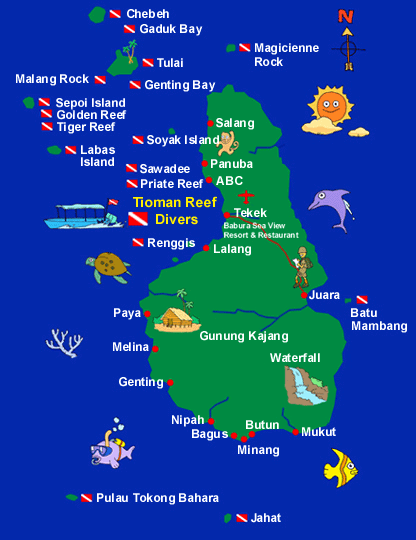
Tioman Island is one of the popular islands in peninsular Malaysia. Be the biggest in the archipelago of about 60 volcanic islands, some inhabited, and situated in the southern shores of the Malaysia East Coast. The size oi the island is about 20 X 12 km (12.5 X 7.5 mi), and boast fabulous tropical beaches set around the mountainous interior.

Tioman Island was first recorded in the journals of Arabian merchants in the tenth century. Traders from India, Persia and China also came this way since Tioman Island had betelnut, sandalwood and camphor to trade and was safe haven from monsoon storms. The island also marked the navigational point at which to head north-east towards Cambodia.

Beautiful landscape of Tioman Island.

Map of the island.

In 1830 the islanders deserted their homes for 15 years, after pirates landed and took 70 people for the slave trade. In the 1920’s the island was again deserted after devastating outbreak of malaria swept through the population. After World War II, when the Japanese detachment used the island as a base, it sank into oblivion until, in the late 1950’s, it was chosen as the setting for the Rogers and Hammerstein musical South Pacific because its unspoiled beauty.

Many coral reefs surround Tioman Island and there are several good dive sites. It is possible to walk across the island in a couple of hours and explore the forest the forest that is home to many species of flora and fauna.


Feeding the fish.

Diving.

There are many resorts provided the facilities for diving activities. The transportation to get into this island too are includes boats and airplanes. Tioman Island is among the greatest for its beautiful corals and crystal clear water.

National Automobile Museum


The National Automobile Museum was a project inspired by Tun Dr. Mahathir Mohamad, Malaysia’s 4th Prime Minister, to showcase the historical development of the transportation system and the national automotive industry as well as the country’s success in its venture into this industry. This two-storey museum, located at the Sepang International Circuit Welcome Centre was opened to the public in March 2004.

Gallery


The exhibition area on the first floor starts with an introduction to the National Automobile Museum as well as the history of the development of Malaysia’s transportation system, followed by two segments, namely the Sepang International Circuit segments and the Classic and Vintage segment. The former showcases the development and the growth of the Sepang International Circuit, the brainchild of Tun Dr. Mahathir Mohamad. The Classic and Vintage segment display a collection of cars, 25 to more than 50 years old, which were previously used in this country and have their own unique history.

The 2nd floor exhibition area is divided into five segments, comprising a display of the national automotive industry which enabling visitors to learn and explore in depth the contributions made by five local companies, namely DRB-Hicom, Proton, Bufori, Modenas and Perodua in leading, developing and promoting this industry.

Collections


The National Automobile Museum displays as many as 22 classic and local models. The models displayed include a collection of six classic and vintage cars, namely the MGTD, Alvis Tourer, Jaguar D-Type, Austin Healy 3000, Ford Speedster and Brushmobile. These models are among the oldest models and one of six found in the world. Among the local and international models on display are Proton, Perodua, DRB-Hicom, Modenas and Bufori.


Facilities

Guided Tours
Mini Library
Washroom

How To Get There

The National Automobile Museum is located approximately 85 km from Kuala Lumpur city centre and is connected with the Middle Ring Road of the North-South Highway (Elite), PLUS Highway, and several other highways as well as the Express Railway link (ERL) route. Taxis and busses heading to the Sepang International circuit can be boarded at the KL Sentral Station or KLIA Sepang.

Nearby Attractions

- Sepang International Circuit

- Kuala Lumpur International Airport

- Low Cost Carrier Terminal (LCCT – now KLIA2)

- Nilai 3 Commercial Centre

- Grilled Fish Centre, Bagan Lalang, Sepang.

- Sepang Gold Coast.

General Information

FREE ENTRANCE

Visiting Hours

9:00 am – 6:00 pm daily
Closed on the first day of Eid al-Fitr and Eid ul-Adha

Address

National Automobile Museum,
International Sepang Circuit,
Jalan Pekeliling, 64000 KLIA,
Selangor Darul Ehsan.
Tel. : 03 – 8787 1499 / 4759
Fax. : 03 – 8787 3732


http://www.jmm.gov.my/ms/museum/muzium-automobile-nasional

Royal Museum, Kuala Lumpur


The Royal Museum, housed at the former National Palace, Jalan Istana, Kuala Lumpur, was the residence of His Majesty and the Yang di-Pertuan Agong and Her Majesty the Raja Permaisuri Agong from 1957 to 2011. The building was then converted to the Royal Museum, which has been open to the public since February 2013. The Royal Museum aims to uphold the Constitutional Monarchy in Malaysia by disseminating knowledge about the role of the institutions of the building itself.

Gallery


The Old National Palace building complex consists of two blocks, namely;

The Balairung Seri Gallery – was built in the 1980s and was used for the official ceremonies of his Majesty, the Raja Permaisuri Agong.

The Royal Mesuem is located approximately 5 kilometers from KL Sentral, via routes heading along Jalan Istana to Jalan Petaling. Visitors can board a taxi or use their own transport following the road signs.

Collections


The Royal Throne

Was fashioned from cengal wood without the use of nails. The steps signify the elevation the elevated that the Throne commands where as the row of five pillars symbolizes the Rukun Negara (The National Principles).

The Dinner Service

The royal dinner service has its own monogrammed cutlery, customized with the seal of the Royal Coat-of-Arms engraved on each piece.

The Royal Coat-of-Arms


Symbolizes the Constitutional Monarchy of Malaysia. The Coat-of-Arms is placed in the center flanked by two sheaves of paddy representing abundance and prosperity.

Ticket Price

Category                                                    Ticket Price

Adult (local citizens / MyCard)                    RM   5.00

Adult (Foreign Tourists).                              RM 10.00

Children (6-12 years).                                   RM   2.00
(Local / MyKid)

Student                                                         RM     3.00
(without uniform 13-17 years old)

Children                                                        RM   5.00
(Foreign tourist 6-12 years old)

Senior Citizens / Disabled                            RM      3.00

Children below 5                                                FREE

Visiting Hours

9:00 am – 5 pm daily
Closed on the first day of Eid al-Fitr and Eid ul-Adha


Address

Royal Museum,
Jalan Istana,
50460 Kuala Lumpur
Tel. : 603 – 2272 1896
Fax  : 603 – 2272 1907

http://www.jmm.gov.my/en/museum/muzium-diraja


Chimney Museum, Labuan (Borneo)


Chimney Museum is a site museum which was erected above a former coal mine at Tanjung Kubong. This museum was established to preserve and disseminate knowledge on the history of coal mining in Labuan, particularly in the area of Tanjung Kubong and around Labuan in the years 1847 to 1911. There is also an on-site mysterious and historic monument known as the Chimney Tower, which was built during the coal mining heyday although the exact date of its construction remains uncertain. The Chimney Museum was officially opened on October 26, 2002.

Collections

The Chimney Museum displays a collection of 612 historical artifacts unearthed during conservation works and archaeological excavations at the Chimney site. These include the original bricks at Chimney; various types of coal mining equipment and items left behind by the miners as well as various archaeological findings unearthed in the vicinity of Tanjung Kubong. Also on display are the remaining structure of a train, which was used to transport coal and different types of coal found around Tanjung Kubong area.


Gallery

The exhibition was presented according to historical chronology and events with related artifacts for the visitors’ better understanding. The visitors can also explore a taste of atmosphere inside a coal mining tunnel through a special diorama. The exhibition’s segments are divided into; Tanjung Kubong’s early history; the history of coal mining and the Labuan Railway; the history of Chimney; Chimney through the centuries; conservation works and archaeological excavations at the Chimney site.

How to Get There

By taxi or public bus no. 6 from the town center, by car take the road from the town center heading towards Jalan Tun Mustapha and then onto Jalan Lubok Temiang. The Chimney Museum is approximately 3 km from the village of Lubok Temiang, located on Tanjung Kubong road.


Facilities

- Parking
- Prayer room
- Washroom
- Bus stop
- Guided tours (upon request)

Nearby Attractions

- Tanjung Aru Fishing Village
- Labuan Bird Park
- Tunnel sites of former coal mine
- Beaches such as Batu Manikar Beach, Pohon Batu Beach and Pancur Hitam Beach.

General Information

FREE ENTRANCE

Visiting Hours

8:30 am – 5:00 pm daily
Closed on the first day of Eid al-Fitr and Eid ul-Adha

Address

Chimney Museum,
Kg. Lubok Temiang,
Jalan Tanjung Purun,
87008 Wilayah Persekutuan Labuan.
Tel. : 087 – 463 603
Fax. : 087 – 414 462


Labuan Marine Museum, Malaysia


The Labuan Marine Museum displays the richness of marine life in Borneo waters particularly Labuan. Its main objective is to promote awareness and love for our natural heritage so that this can be preserved for the continued enjoyment by future generations.

The Labuan Marine Museum is housed at the International Sea Sports Complex in a two-storey building designed in the shape of a shell. The museum was officially opened on January 26, 2003.

Collections

The Labuan Marine Museum features a collection comprising 572 marine specimens and contemporary items such as fishing, diving and oceanography equipment. The Museum’s main attraction is the 100 years old skeleton of a baby Indian Fin Whale, which is 42 feet long and a preserved Dugong. This marine mammal was found stranded on Papan Island, one of the small island off the coast of the Federal Territory of Labuan.


Gallery

The ship-like designed gallery is made up of the ground and the first floor.

The ground floor gallery is divided into four sections; Marine Life; Shipwreck; Reef; and the Mangrove section that features habitats found in the mangrove areas showcased in the form of a diorama. This gallery houses 14 aquaria of varying sizes and a ‘touch pool’ that offers visitors the opportunity to touch all kinds of marine life.

The first floor features the habitats of various ocean species, traditional fishing equipment and traps as well as diving gear. There are also four aquaria showcasing coral life and two reading corners for public.


How to Get There

By Taxi: 10 minutes’ drive from both the Waterfront and Sheraton Hotels
By Bus: bus No. 1

Facilities

- Parking
- Washroom
- Prayer room
- Food stalls
- Souvenir shops
- Labuan Marine Centre
- Guided tours (upon request)

Nearby Attractions

- Labuan Clock Tower
- Tanjung Purun Beach
- Labuan Botanical Garden
- Sawangan Cina Beach

General Information

FREE ENTRANCE

Visiting Hours

9:00 am – 5:00 pm daily.
Closed on the first day of Eid al-Fitr and Eid ul-Adha.

Address

Labuan Marine Museum,
Labuan International Sea Sport Complex,
Jalan Tanjung Purun,
87008 WP Labuan.
Tel. : 087 -  425 927 / 414 135

http://www.jmm.gov.my/ms/museum/muzium-marin-labuan

The Malay World, Ethnology Museum

Ethnology Museum located nearby the Sentral Station, Kuala Lumpur

The idea for the establishment of the Malay World Ethnology Museum was first proposed by Malay scholars during the Conference of Malay Civilization in 1989. The design concept concept of the museum is inspired by a traditional Malay house, which can clearly be seen on the design of its porch and rooftop. This museum was officially opened to the public in March 2002.

Gallery

The Malay World Ethnology Museum focuses on the diversity of Malay society and culture in Malaysia through highly aesthetic collections of artefacts, such as traditional arts, clothing and jewelry, traditional games and weaponry. In addition, the depiction of the social and cultural life of the Malays in Malaysia in the gallery in portrayed by dioramas of a Malay traditional village; a Wayang Kulit (shadow play) theatre; a Malay wedding dais; and the making of Wau Bulan (moon-kites).

Shadow play with traditional characters.

Among others exhibit in the museum.

Collections

Among the fascinating collections on display are the Cik Siti Wan Kembang dress; the wedding dais of Perak; wayang kulit (shadow play) figures; a variety of replicas of perahu (boats); variously shaped congkak boards; wau bulan (moon-kites); musical instruments; wood carvings; and traditional weapons such as the keris, cannon, spear, sundang (sword) and others.

How To Get There

Located within the compound of the National Museum, visitors can take a taxi or bus (KL City Shuttle for a day trip) at KL Sentral Station or via alternative transportation centered at the KL Sentral Station such as the Commuter, Putra LRT, Monorail, or by walking approximately 1.3 km to the museum.

Traditional moon-kite highly decorated from East Coast of Malaysia.

Nearby Attractions

- Perdana Lake Garden

- Planetarium

- Islamic Art Museum

- Bird Park

- Tun Abdul Razak Memorial


Facilities

- Café

- Parking

- Prayer room

- Rest hut

- ATM Machine


General Information

Free Entrance


Visiting Hours

9 am – 6 pm daily
Closed on the first day of Eid al-Fitr and Eid ul-Adha


Address

Malay World Ethnology Museum,
Jalan Damansara
50566 Kuala Lumpur
Tel: 03 – 2282 6255 ext: 340 / 182 / 181


The Galeria Perdana


The Galeria Perdana was the inspiration of Malaysia's 4th Prime Minister, Tun Dr. Mahathir Mohamad and Tun Dr. Siti Hasmah Mohd Ali. This gallery was built as a repository and to display and share the various awards, souvenirs and gifts reveived by Tun Dr. Mahathir during his regime as Prime Minister of Malaysia. The Galeria Perdana officially opened to the public from April 1996.

Collections

The collection of vehicles and their miniature models are the main attraction of this gallery. Sculptured stone titled 'Windows of Opportunity' crafted by a famous Zimbabwean, Gerald Takawira, and a traditional ship known as Bahtera Purba also been displayed in the gallery compound.

Gallery


More than 9000 collections comprising various materials and media are displayed on a ratational basis, to ensure that visitors to the gallery will be able to enjoy different collections each time they visit the Galeria Perdana.

Block A displays the collection of gifts and souvenirs made of wood, lacquer, crystal and glass, including some precious collection of ceramics and textiles presented to Tun Dr. Mahathir.

Block B houses a collection of souvenirs belonging to Tun Dr. Siti Hasmah as well as items made from silver, bronze, pewter and copper. A collection of paintings, jewellery, vehicles and miniature models of vehicles are also displayed in Block C.


How To Get There

The Galeria Perdana is located approximately 13 km from Kuah Jetty or 20 km from the Langkawi International Airport. Transport by taxi to the gallery is also available.

Facilities

- Souvenir shop
- Café / Wifi
- Mini Library
- Auditorium
- Parking bays for cars and coaches
- Washroom

Nearby Attracrions

- Kilim Geopark
- Gunung Raya Resort
- Langkawi Sky Bridge
- Dayang Bunting Island

Entrance Fees

Category                                            Ticket Price

Adult (local citizens / MyCard)                    RM   5.00
Adult (Foreign Tourists).                              RM 10.00

Children (6-12 years).                                 RM   2.00
(Local / MyKid)

Children (6-12 years)                                  RM   4.00
(Foreign Tourist)

Primary School Children                             RM     1.00
(6-12 years) in uniform@school parties
With approval letter.

Secondary School Children                        RM      2.00
(6-12 years) in uniform@school parties
With approval letter.

Higher Learning Students/College              RM     3.00
(Student Card)

Senior Citizens
(with MyCard/Retirement Card)                   RM      3.00

Camera                                                       RM      2.00
Video Camera.                                            RM       5.00

Visiting Hours

9am - 6pm daily
Closed on the first day od Eid al-Fitr and Eid ul-Adha

Address

Galeria Perdana,
Jalam Kilim, Air Hangat,
07000 Langkawi,
Kedah Darul Aman.

Tel.    : 604 - 9591 498 / 9592 863
Fax.   : 604 - 9591 819

http://www.jmm.gov.my/ms/meseum/galeria-perdana
www.facebook.com/GaleriaPerdana


Diving In Malaysia


Malaysia known to be one of the best diving destination and ultimate diver's paradise. Sabah's Sipadan, Malaysia's sole oceanic island, was described by the famous oceanographer, Jacques-Yves Cousteau as 'a piece of untouched art'. Few islands in the world offer such prolific marine and coral life as Sipadan. Other world-renowned diving desrination are Langkawi's Pulau Payar, Terengganu's Redang and Pahang's Tioman, to name a few.

Due to its strategic location, a vast assortment of marine life can be found in the waters of Malaysia. Some of it's islands possess an enviably diverse underwater ecosystem, with several rare, exotic and endangered species. Coral gardens in a riot of colors can be found in abundance in the waters of Terengganu and Sabah, particularly around Redang and Sipadan, while short-finned pilot whales have been sighted in the waters of Layang-Layang in Sabah.

Wreck Sites

Malaysia is home to some of the best wreck sites in the world - some of which date back to the World War II. Labuan in the best destination in the country for the wreck-diving with four wreck sites. Johor's Aur and Sabah's Mantanani, Layang-Layang and Lankayan also have wreck sites that are worth exploring. Discover a wide variety of marine species that make the wreck sites either their home or their playground.

Muck Diving & Macro Diving

The island of Sabah, particularly the ones off Semporna, are the best destination for muck diving and underwater macro photography. Mabul is a prime destination for this with its wealth of macro life. Nearby Sipadan and Kapalai are also popular muck and macro diving destinations with its extensive variety of nudibranchs, frog fishes, leaf fishes and pigmy seahorses, just to name a few.


Diving Facilities & Courses

Most resort operators, particularly on the more popular island, also have their own dive centres which provide complete diving facilities. Dive equipment can be rented here, but the amount available could limited, especially during peak seasons, so it would be wise to book in advance. Some of these centres even offer diving courses, where visitors can learn how to dive and even get certificate at the end of it.

Best Time to Dive

The best times to dive differ from one place to another. For dive sites along the West Coast of Peninsular Malaysia, the best times would be from December to May, while for the ones along the East Coast would be from March to October. The islands around Sabah and Sarawak are reasonably well-protected and safe for diving anytime. Water visibility, however, is at its best from April to August.


Malaysia’s Taste Buds - Rendang

Rendang considered one of the most important cuisine for Hari Raya.  

Rendang always be the most important menu on the becoming celebration of Hari Raya. So I decided to include it in my list of articles. It is one of the most important cuisine in Malay culture that enjoyed by all Malaysian and the knowledge about Rendang will allow us to enjoy it more.
 
Rendang is prepared usually use coconut milk so long until it becomes dry. Rendang originates from Indonesia and is very popular in the Sumatera, especially in the districts of Padang. It is not surprising that in the district of Padang’s Rendangs has more variation using more main ingredients.
 
In Malaysia key ingredients used in the preparation usually consists of chicken, beef (cow / goat / buffalo / deer, etc.) and rarely of other types such as fish or vegetables. Rendang prepared occasional for the cooking time take longer than other daily dishes. But for those who in restaurant business will surely seek to provide a shady every day because it is the customer's request.

Chicken's Rendang.
Rendang with 'Maman' (type of vegetable) popular in Negeri Sembilan.  
 
Rendang is popular as food in the feast, and practically every house would prepare rendang for the family and visitors. Anyway these rendangs are not identical from one another. This becomes one of the best things about rendang as it can be prepared in various ways. However, there are few types of popular among them; Rendang Tok , Rendang Dinding, Rendang Neghoghi (Negeri) and Rendang Padang .
 
While in terms of the ingredients, there are some important ingredients that been used for most types of rendang such as; chili, garlic, scallion, coconut milk, lemongrass, ginger, galangal, turmeric, turmeric’s leaves, lime leaves and coconut paste. Other materials may be used in some other rendang types listed earlier, but these ingredients are that commonly used.

Rendang Tok popular in the North State of Perak.
 
There are several main purposes of why rendang is important;
 
·     It lasts longer; it usually prepared in large quantities and can be consumed for few days during the festive season.
·    Using matured meet (from old chicken or other meats) as these meats can stand for a longer cooking time. For rendang an old chicken meat can be the best type of meat even though it might be not suitable for other daily dishes.
·    Rendang is easy to carry because it was cooked until almost dry – there will be no sauce to spill.
·    Rendang can easily match with other foods – that will prepared together during the Hari Raya festive. It can be eaten with ketupat, soto, lontong, fried noodles or fried ‘rice noodles’ but also with the 'nasi lemak'.
 
As said earlier rendang is popular in the area of Padang in Sumatra as it has more variations there. It wills great if we can learn a little bit about rendang from Padang. First the 'Rendang Lumek' (cooked until dry and pulverized) prepared using fish meat known as ‘gabus’ and leaves. This Rendang is rare now because the fish is hard to find.

Perfect pairs of Rendang and Lemang.
 
Eggs also been used in rendang from Padang District, using flour mixed eggs , steamed and cut into small pieces. In contrast to today rendang prepared using egg omelet. The following is ‘Rendang Runtiah’ using shredded beef, shredded into small pieces and other types are the cow’s lungs, eels, and fish and so on.
 
I hope that will be a helpful information about rendang that we need to know in order to make this year rendang consuming will be little bit different. It is not easy to prepare the rendang during Ramadan with all other prepartion for the becoming festive of Hari Raya in Malay culture. Hopefully all the preparation will be enjoyed by all other family members with joy and laughter and for that all of the foods will be blessed.


LinkWithin

Related Posts Plugin for WordPress, Blogger...